How Large Language Models Actually Work
Kevin Badinger · March 14, 2026
A no-jargon guide to how LLMs learn, think, and fail — written for smart non-ML people who want the real story without tensor calculus.
Layer 1: The Dinner Table Explanation
LLMs function like someone who has read everything and learned communication patterns. They store relationships between ideas — how concepts connect, how sentences flow, how reasoning works — rather than facts in files.
Think about how a doctor diagnoses a rare drug reaction, a mechanic identifies a transmission problem by sound, or a chess grandmaster recognizes board patterns. All of these involve pattern recognition at scale. That's the same mechanism LLMs employ — just applied to language.
Layer 2: How LLMs Actually Learn
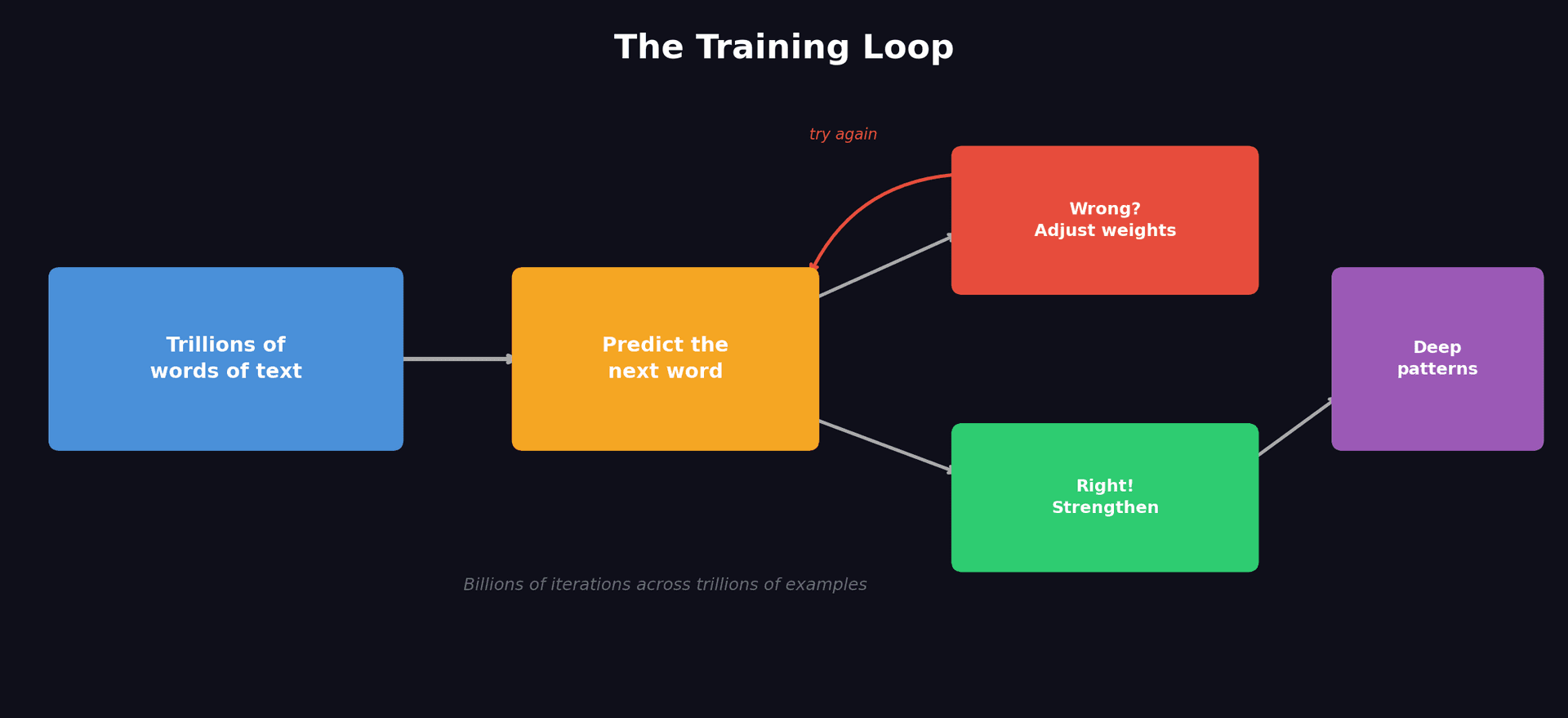
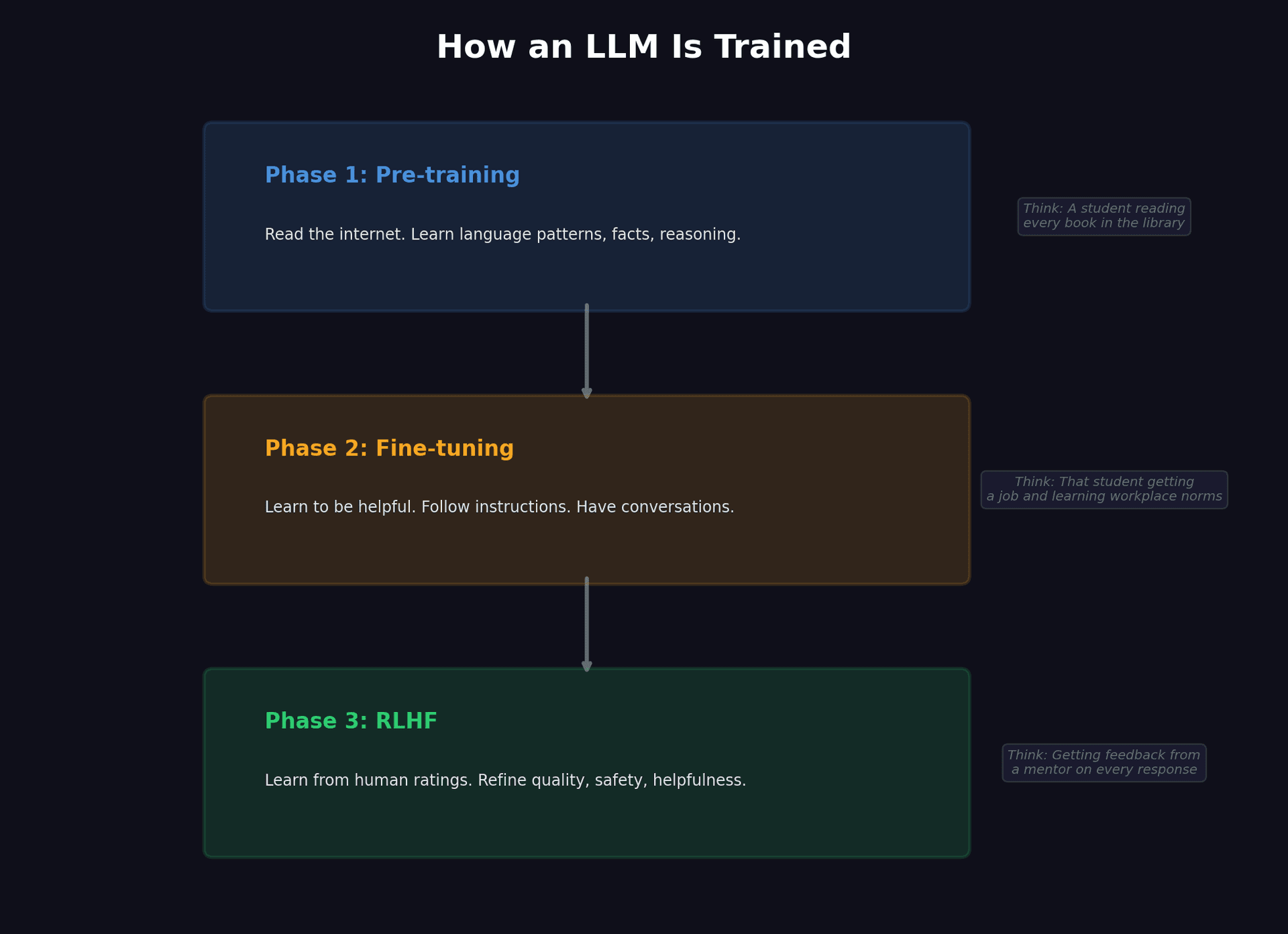
Pre-training (The Big Read): Models play a word-prediction game across trillions of words. This isn't shallow autocomplete — correctly predicting medical or coding text requires grasping the underlying concepts.
Fine-tuning: Humans show the model examples of helpful conversations, teaching it how to respond usefully rather than just predict the next word.
RLHF (Reinforcement Learning from Human Feedback): Humans rate responses, guiding the model toward preferred outputs — more helpful, less harmful, more honest.
The physical reality: Training requires thousands of GPUs running for months, consuming electricity comparable to a small town's yearly usage. This isn't a laptop project.
Layer 3: How It Generates Responses
Tokenization: Your text gets converted to numerical representations the model can process.
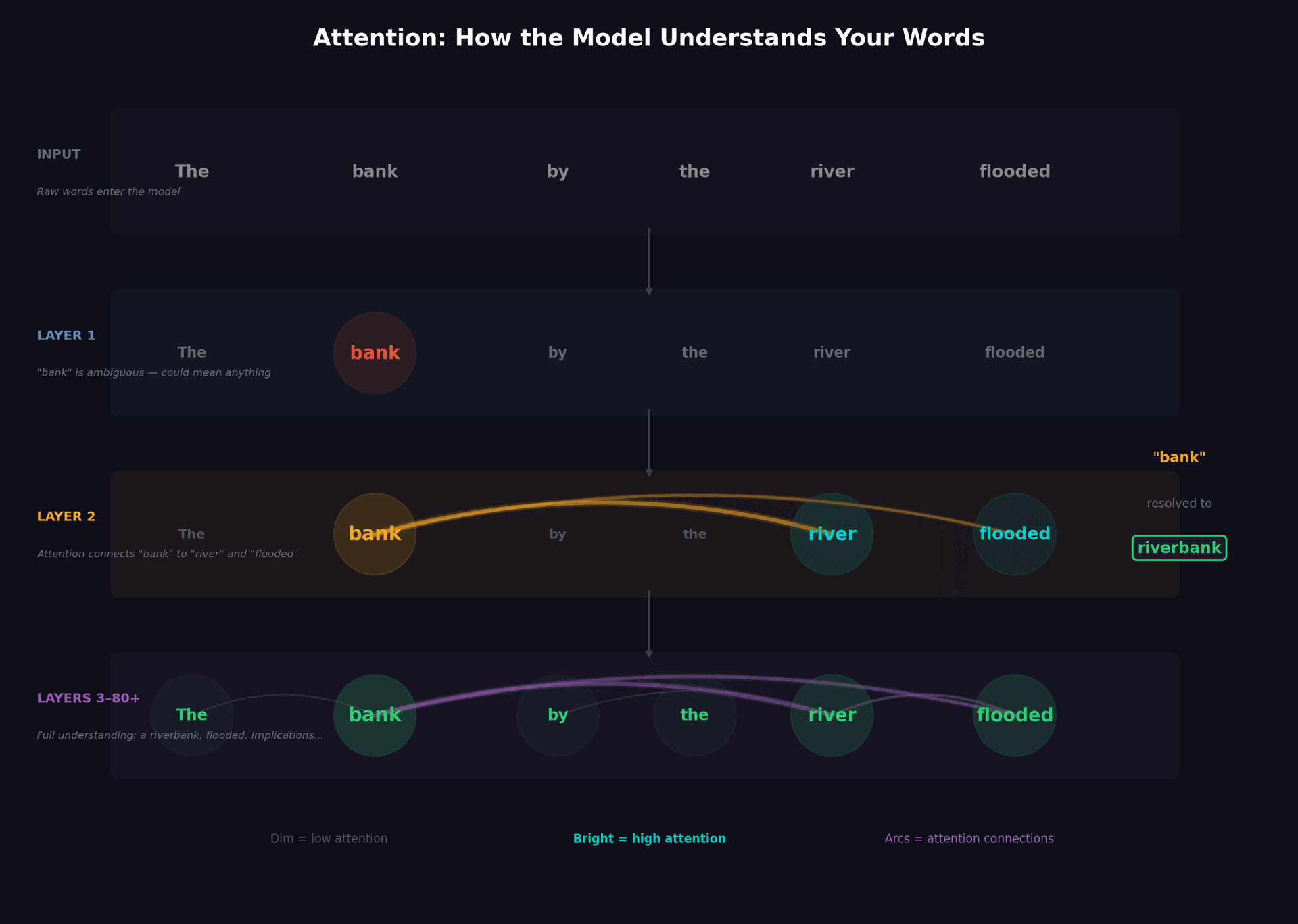
Attention & Transformers: The model determines which words relate to which others across 50+ stacked layers, building progressively deeper understanding of what you're asking.
Token generation: The model creates its response one token at a time, like jazz improvisation — each note informed by everything that came before it.
Why Hallucinations Happen
An LLM is not Google. It's not looking anything up. Models rebuild knowledge from patterns, not retrieve stored facts. This means confident false statements result from the same mechanism that enables creative connections — like a doctor's pattern-matching sometimes producing the wrong diagnosis.
Understanding this distinction is critical for any organization adopting AI tools. The hallucination problem isn't a bug to be fixed — it's a fundamental property of how these systems work. Your governance and training frameworks need to account for it.
Layer 4: Vectors and Embeddings
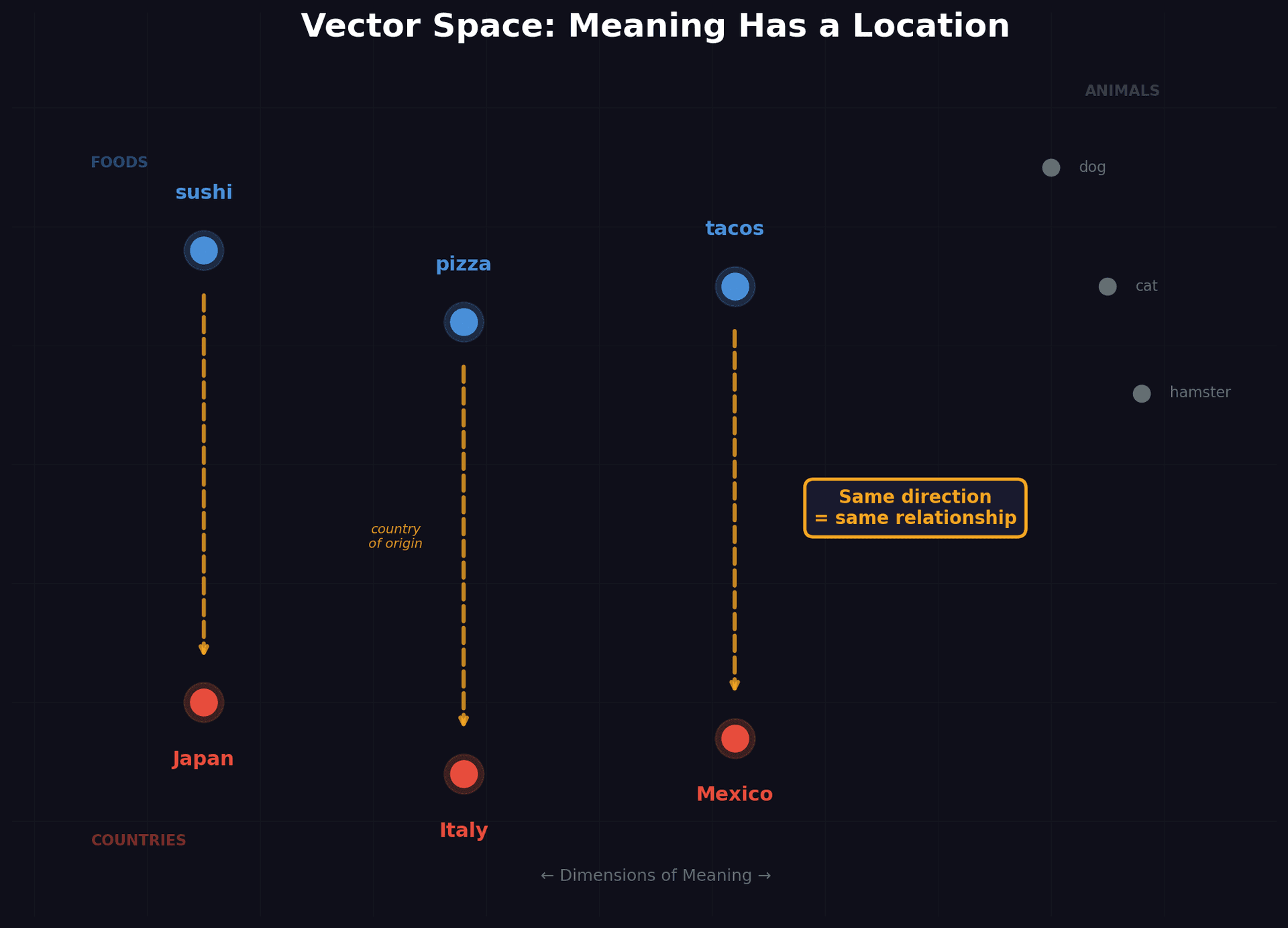
The actual intelligence lives in geometric relationships between concepts in high-dimensional space. The model discovered on its own that "sushi → Japan" relates to "pizza → Italy" the same way — learning abstract concepts like "cultural origin" as directions in meaning-space.
Parameters — billions of adjustable numbers — encode these relationships. More parameters generally mean smarter models, but the relationship isn't linear.
Layer 5: Emergence and the Path to AGI
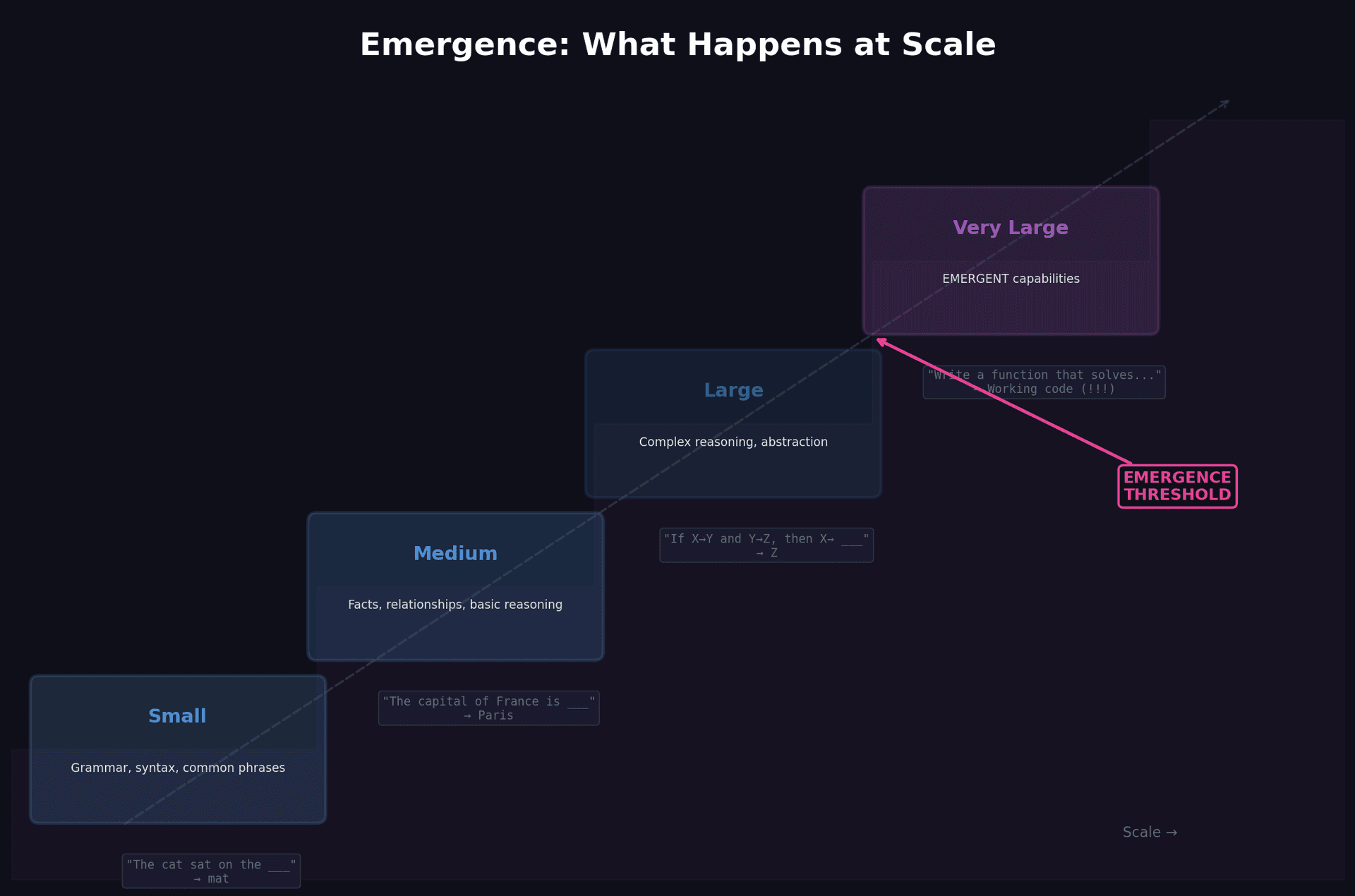
Unexpected abilities appeared when models scaled: solving novel math problems, writing functional code, understanding humor. This emergence happens because predicting text deeply enough requires something that looks a lot like genuine understanding.
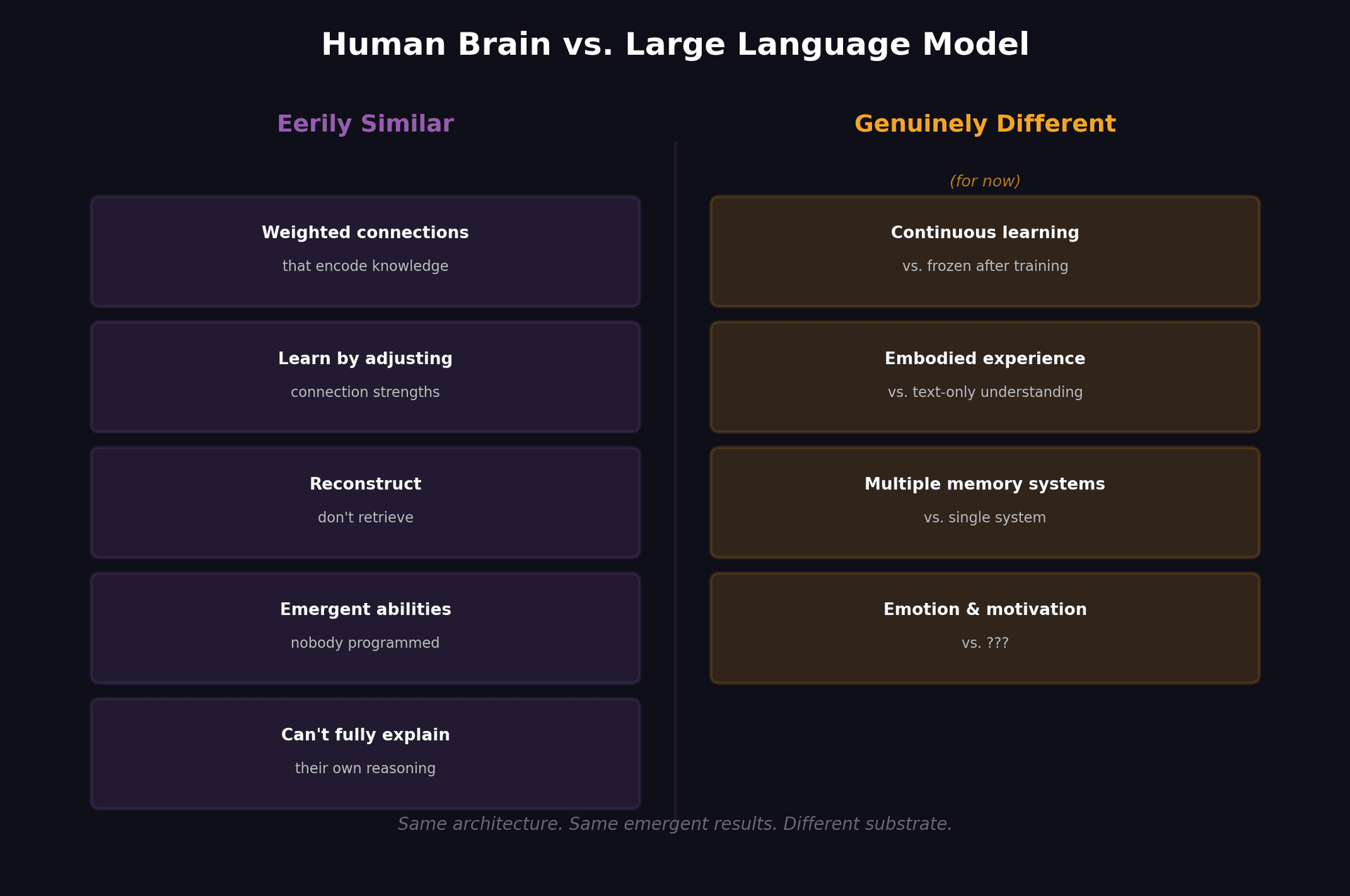
LLMs parallel human brains in interesting ways: both adjust connection strengths during learning, both reconstruct rather than retrieve knowledge, both confabulate confidently, and both develop abilities that weren't explicitly programmed. Key differences: humans learn continuously, understand through embodied experience, and are driven by emotion and motivation.
Regarding sentience — models display understanding-like capabilities, but whether subjective experience exists remains unknowable. Three schools of thought address the path to AGI: scaling alone suffices; LLMs are one piece requiring persistent memory and learning; or this approach fundamentally cannot get there. Annual breakthroughs continue to exceed expert predictions.
The Practical Takeaway
How does AI work? It learns patterns from massive text, stores meaning as mathematical relationships, then navigates that space to construct answers.
Is it intelligent? Understanding emerged unprogrammed. It's genuine, but perhaps not identical to human intelligence.
What does this mean for your organization? You can't make good decisions about AI adoption if you don't understand what it actually is. This isn't magic and it isn't a search engine. It's a powerful pattern-recognition system with real capabilities and real limitations. Your adoption strategy needs to respect both.